

How Water Purifiers Work (RO, UV, UF Explained)
Clean drinking water is essential for a healthy life, but in today’s environment, water contamination is a serious concern. Tap water may contain harmful substances such as bacteria, viruses, chemicals, and heavy metals that are not visible to the naked eye.
This is where water purifiers play a critical role. Understanding how water purifiers work can help you make better decisions for your health and your family.
Modern water purification systems use advanced technologies such as Reverse Osmosis (RO), Ultraviolet (UV), and Ultrafiltration (UF) to remove different types of impurities.
In this complete guide, we will explain each technology in detail and help you understand which purifier is best for your needs.
What is a Water Purifier
A water purifier is a system designed to remove harmful contaminants from water and make it safe for drinking.
It improves:
Water safety
Taste and odor
Clarity
Mineral balance
A good water purifier ensures that the water you drink is free from harmful substances while maintaining essential nutrients.
Why Water Purification is Important
Water from natural and municipal sources may contain:
Bacteria and viruses
Heavy metals like lead and arsenic
Chlorine and chemicals
Dissolved salts and impurities
Drinking such contaminated water can lead to serious health issues including digestive problems, infections, and long-term diseases.
This is why using a proper water purification system is not optional anymore—it is necessary.
Types of Water Purification Technologies
The three most commonly used purification technologies are:
RO (Reverse Osmosis)
UV (Ultraviolet)
UF (Ultrafiltration)
Each technology works differently and targets different types of contaminants.
How RO Water Purifiers Work
Reverse Osmosis is one of the most advanced and widely used water purification technologies.
Working Principle
RO uses a semi-permeable membrane that allows only water molecules to pass through while blocking impurities.
Step-by-Step Process
Water first passes through a sediment filter to remove dust and particles
It then goes through a carbon filter to remove chlorine and bad odor
High pressure pushes water through the RO membrane
The membrane removes dissolved salts, heavy metals, and chemicals
Clean water is stored, and impurities are flushed out
What RO Removes
Dissolved salts
Heavy metals
Fluoride
Nitrates
Harmful chemicals
Advantages
Provides highly purified water
Suitable for high TDS water
Improves taste
Limitations
Removes essential minerals
Wastes some water during purification
How UV Water Purifiers Work
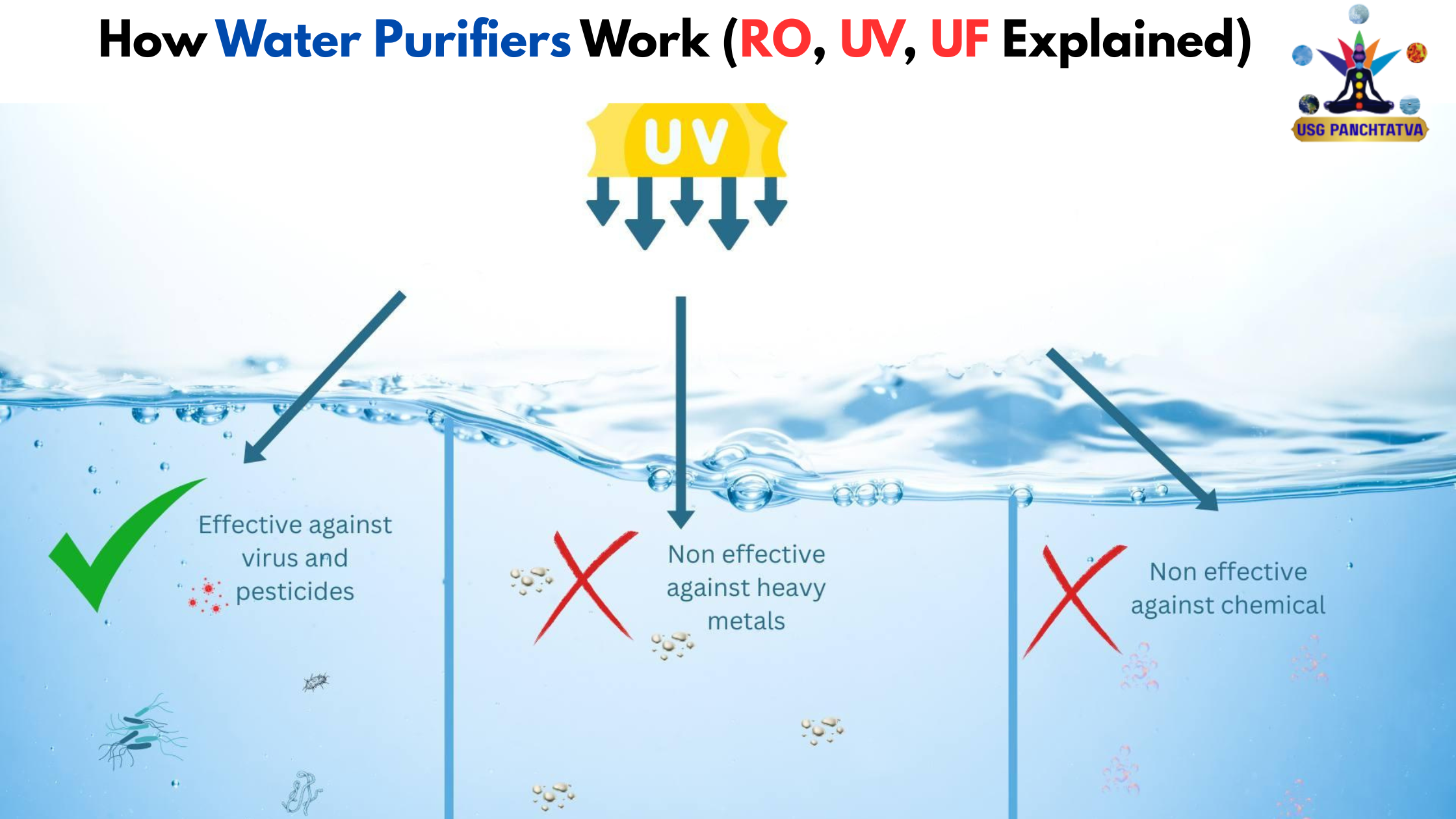
UV purification focuses on eliminating microorganisms from water.
Working Principle
UV purifiers use ultraviolet light to destroy harmful bacteria and viruses.
Step-by-Step Process
Water flows through a UV chamber
UV light penetrates microorganisms
DNA of bacteria and viruses is destroyed
Microorganisms become inactive
What UV Removes
Bacteria
Viruses
Pathogens
Advantages
Chemical-free purification
Highly effective against microbes
Maintains natural taste
Limitations
Does not remove dissolved impurities
Requires electricity
How UF Water Purifiers Work
Ultrafiltration is a physical filtration process using a membrane.
Working Principle
UF uses a hollow fiber membrane to filter out suspended particles and microorganisms.
Step-by-Step Process
Water passes through UF membrane
Suspended particles and bacteria are blocked
Clean water flows through
What UF Removes
Dust and particles
Bacteria
Suspended impurities
Advantages
No electricity required
Retains minerals
Low maintenance
Limitations
Does not remove dissolved salts
Not suitable for high TDS water
RO vs UV vs UF – Key Differences
RO removes dissolved impurities and heavy metals
UV kills bacteria and viruses
UF removes suspended particles
Most modern purifiers combine all three technologies to provide complete purification.
Multi-Stage Water Purification Process
Advanced water purifiers use multiple stages to ensure better purification.
Typical stages include:
Sediment filter
Carbon filter
RO membrane
UV purification
UF filtration
Mineral cartridge
This multi-layer system ensures maximum safety and better water quality.
Importance of Mineral Balance in Water
While purification is important, maintaining essential minerals is equally important.
Minerals such as:
Calcium
Magnesium
Potassium
are necessary for hydration and body function.
Advanced purifiers include mineral cartridges to restore these minerals.
How to Choose the Right Water Purifier
Choosing the right purifier depends on your water quality.
If your water has high TDS, choose RO
If your water contains bacteria, choose UV
If your water has visible particles, choose UF
For best results, choose a combination system such as RO + UV + UF.
Maintenance of Water Purifiers
To ensure proper performance:
Replace filters regularly
Clean storage tank
Check system performance
Service the unit periodically
Poor maintenance can reduce purification efficiency.
Common Myths About Water Purifiers
Many people believe that boiling water is enough, but boiling only kills bacteria and does not remove chemicals or heavy metals.
Another myth is that all purifiers are the same, which is not true. Each technology has a specific purpose.
Frequently Asked Questions
Which water purifier is best
A combination of RO, UV, and UF is best for most households.
Does RO remove minerals
Yes, but modern systems add minerals back.
Is UV water safe
Yes, it kills harmful microorganisms.
Do I need a water purifier at home
Yes, especially if water quality is uncertain.
Conclusion
Understanding how water purifiers work is essential for choosing the right system for your home. Technologies like RO, UV, and UF each play an important role in removing different types of contaminants.
A good water purifier not only ensures safety but also improves water quality and supports better health.
Investing in the right purification system is one of the best decisions you can make for your family’s well-being.

